
Beginner Gym Routine: A Simple Plan That Actually Works.
Note: This programme is for educational purposes and provides a general structure for healthy individuals. It is not personalised coaching. By following these exercises, you acknowledge you are doing so at your own risk. Please read my Health & Liability Disclaimer before starting this routine.
This beginner gym routine is designed to be simple, effective and realistic, especially if you’re new to the gym. So, if you’re looking for a gym routine for beginners that actually works, this is a great place to start.
Starting the gym can feel overwhelming. You walk in, see loads of equipment, and have no idea what you should actually be doing.
If you’ve ever searched for a beginner gym routine and yet still felt confused, don’t worry – so have I!
The truth is, most beginner routines either overcomplicate things or aren’t actually designed for beginners at all. You don’t need anything complicated. Just something simple that you can actually stick to.
In this guide, I’ll show you exactly how to build a beginner gym routine that actually works, and you can follow straight away.
This beginner gym routine works whether your goal is building muscle, losing fat, or simply feeling more confident in the gym.
So you can finally stop guessing and start making progress.
Want a simple plan you can actually follow in the gym?
I’ve put this exact routine into a free, easy-to-follow PDF you can take with you.
Get it sent to your inbox here ↓
By signing up, you’ll receive my routine + occasional emails from me. You can unsubscribe anytime.
What Makes a Good Beginner Gym Routine?
A good beginner gym routine should be simple, easy to follow, and focus on the basics. You don’t need loads of exercises or a complicated split to make progress.
One of the biggest mistakes beginners make is jumping straight into what people often call a “bro split” – where you train one-two muscle group per session (like back and biceps one day, legs the next). While this can work later on, it’s not the best place to start.
As a beginner, your priority should be building strong foundations. That’s why full body workouts are usually the best option. They allow you to train all major muscle groups multiple times per week, which is ideal for learning movements and making steady progress.
Even now, after a couple of years of training, full body sessions are still one of my favourite ways to train. They’re simple, effective, and easy to stay consistent with.
Your routine should also include progressive overload. This just means gradually making your workouts more challenging over time so your body continues to adapt.
This could be:
- Increasing the weight
- Doing more reps
- Adding an extra set
- Improving your form and control
You don’t need to change everything at once. Small improvements over time are what actually lead to results.
And most importantly, consistency will always beat perfection. A simple routine you stick to is so much better than a “perfect” plan you give up on after a week.
Another big benefit of full body training is that it’s forgiving. If you miss a session, you haven’t completely skipped a muscle group, which makes it much easier to stay on track.
This is why a full body beginner gym routine is often the best place to start.
If you don’t want to build this yourself, I’ve already done it for you.
The Biggest Mistakes Beginners Make
Some of the biggest mistakes I see beginners make are actually really common, and most people don’t even realise they’re doing them.
Jumping in too quickly
Instead of sticking to the basics and learning proper technique, a lot of people copy advanced routines from influencers who have been training for years. Will that work? Probably. But is it optimal for a beginner? Not at all.
As a beginner, you don’t need a complicated split. You need a simple plan that helps you build confidence, learn movements properly, and stay consistent.
Doing random workouts every session
I used to do this myself. I’d turn up to the gym, use a few random machines, and leave thinking I’d had a good workout.
The problem is, progress comes from repetition. If you’re constantly changing what you’re doing, you can’t track progress properly, and you don’t give your body a chance to improve.
Doing too much cardio and avoiding weights
Cardio is great, and it should be part of your routine, but it needs to be balanced with strength training.
If all you’re doing is going on the stair master or treadmill, you’re not building muscle or strength, no matter how long you spend on it. And if your goal is things like growing your glutes or getting stronger, weights need to be part of your routine.
Not tracking progress
If you’re using the same weights every week and not changing anything, your body has no reason to adapt.
To see real progress, you need to be tracking your workouts. This can be as simple as writing down your weights, reps, and sets, and aiming to improve them over time.
This way, you actually give yourself a bit of structure and consistency with your training.

How Many Days Should Beginners Train?
How many days you should train depends on your current fitness level, but most beginner gym routines work best with fewer, consistent sessions.
If you’re new to the gym or coming back after a long break, jumping straight into a 5-day “bro split” isn’t usually the best option.
A good starting point is 2–3 days per week. This gives your body enough time to recover between sessions, which is where progress actually happens.
Remember that recovery is just as important as the workouts themselves. If you’re constantly training without giving your body time to adapt, you’re more likely to feel run down, lose motivation, or even get injured.
I see a lot of beginners make the mistake of doing too much too soon. I actually did this myself when I first started. I didn’t just do a 5-day split… I was training 7 days a week, sometimes even doing two workouts in one day.
On paper, it sounds like I was being “consistent”. But in reality, it wasn’t sustainable at all.
Yeah, okay, I lost weight, but I was also massively under-eating for the amount of exercise I was doing. I was eating around 1400 calories while training every single day – a recipe for disaster I think.
I felt constantly exhausted, I got ill for months, and my overall health took a massive hit. At the time I thought I was just being ‘disciplined’… turns out I was just running myself into the ground. I had no idea that doing too much exercise (and not fuelling it properly) was actually part of the problem.
This is why starting with a manageable routine is so important.
You don’t need to train every day to see results. A simple routine that you can stick to consistently will always be more effective than doing too much and burning out.

Simple Beginner Gym Routine (3-Day Plan)
If you’re not sure where to start in the gym, this simple 3-day routine is one of the best places to begin.
You’ll be training 3 times per week, using two full body workouts that are easy to follow and effective for building strength.
How this routine works
This routine is built around simple, effective movements (often called compound exercises) that train multiple muscle groups at once.
This routine is built around a “Rolling A/B Split.” Basically, you just alternate workouts each time you go. It’s great for full-body training because it ensures every muscle group is hit frequently while allowing for maximum recovery.
You will alternate between Workout A and Workout B every time you hit the gym. Because you are training 3 days a week, your schedule will look like this:
- Week 1: Workout A / Workout B / Workout A
- Week 2: Workout B / Workout A / Workout B
By alternating each week, you ensure that over a 14-day period, you have performed both workouts exactly three times. This creates perfect balance between your upper and lower body, preventing any one muscle group from lagging behind.
Example 2-Week Schedule
| Day | Week 1 | Week 2 |
|---|---|---|
| Monday | Workout A | Workout B |
| Wednesday | Workout B | Workout A |
| Friday | Workout A | Workout B |
Simply pick up where you left off. If you finished Friday on Workout A, your next session on Monday is Workout B.
Note: This programme is for educational purposes and provides a general structure for healthy individuals. It is not personalised coaching. By following these exercises, you acknowledge you are doing so at your own risk.
Workout A – 3 sets – 8-12 reps
- Squats
- Chin-ups (assisted)
- Chest Press (machine)
- Tricep Pushdown
- Abs Circuit
Workout B – 3 sets – 8-12 reps
- Romanian Deadlifts
- Hip Thrusts
- Seated Rows
- Overhead Shoulder Press
- Abs Circuit
If you struggle with chin ups, or haven’t got an assisted machine, you can use resistance bands like these
Important notes
This routine is designed to be simple and effective.
The main focus, especially as a beginner should be:
- learning proper form
- controlling each movement
- staying consistent
- gradually improving over time
You don’t need to rush. Start with weights that feel manageable and build from there.
Movement outside the gym
You don’t need to add extra workouts to see results.
However, staying generally active throughout the week can be helpful. This could be as simple as:
- walking more
- getting your steps in – I track mine using my Samsung Galaxy Watch
- doing something active you enjoy
This is completely optional and should never feel like something you have to do.
Beginner Gym Routine for Females
If you’ve searched for a “female-specific” routine, you’ve probably seen plans that look nothing like a standard strength program. The truth? Women don’t need a “special” routine. The same principles of getting stronger and using compound movements apply to everyone.
However, many women do prefer a slight emphasis on the glutes and lower body.
By using the Rolling A/B Split (alternating weeks), you get the best of both worlds. In “Week B” (the B/A/B week), you’ll hit your glutes and hamstrings twice with heavy hitters like Romanian Deadlifts and Hip Thrusts. Then, in the following week, you give those muscles a bit more recovery time while you focus on upper body strength in “Week A.”
This setup naturally balances things out so you’re not smashing the same muscles every session. This is what keeps the routine effective and prevents you from hitting a plateau.
How to Progress Your Routine
When it comes to progressing your routine, you don’t need to do anything crazy. Honestly, it’s just about doing a little bit more over time.
This is what’s known as progressive overload. It sounds complicated, but it really isn’t. It just means gradually making your workouts slightly harder so your body has a reason to adapt.
That could be:
- adding a bit more weight
- doing an extra rep or two
- adding a set
- slowing the movement down and controlling it more
Looking at the routine above, let’s say in week 1 you do squats for 20kg and hit 10, 9, 8 reps across your 3 sets.
The following week, even getting 11, 10, 8 is still progress. It might not feel like much, but those small improvements add up over time.
Another thing a lot of people overlook is improving your form. This honestly makes a bigger difference than people think.
For example, if your squat isn’t quite hitting depth yet, working on that is going to be way more beneficial than just throwing more weight on the bar.
It also helps to get enough protein in to support muscle growth. I use Protein Works to boost mine.
To be honest, that’s all you need to focus on as a beginner. Small improvements, done consistently.
How Hard Should You Train?
When it comes to how hard you should train, you want your workouts to feel challenging, but not to the point where you’re completely destroyed after every session, especially when you’re just starting out.
A simple way to judge this is using something called RPE (rate of perceived exertion). It sounds a bit technical, but it’s really just a scale from 1 to 10 that describes how hard something feels.
1 is basically no effort at all… like you could do it half asleep, and 10 is you physically cannot do another rep, no matter how hard you try.
Most of your sets should sit somewhere around a 7 to 9. So you should feel like you’re working hard, but still have roughly 1 to 3 reps left in the tank.
To be honest, if every single set feels like a 10, you’re probably doing too much. And if everything feels like a 4 or 5, you’re probably not pushing yourself enough to see progress.
It’s about finding that middle ground where it feels challenging, but still manageable enough that you can recover and come back for your next session.
A really common mistake, especially for beginners, is going too hard too soon. You might feel motivated and push every set to the absolute max, but then you end up so tired you can barely finish the rest of your workout.
Over time, this can also make it harder for your body to recover properly between sessions, which actually slows down your progress rather than speeding it up.
For most people, you’ll get much better results by pacing yourself across the whole workout, rather than going all-out on the first exercise and having nothing left for the rest.
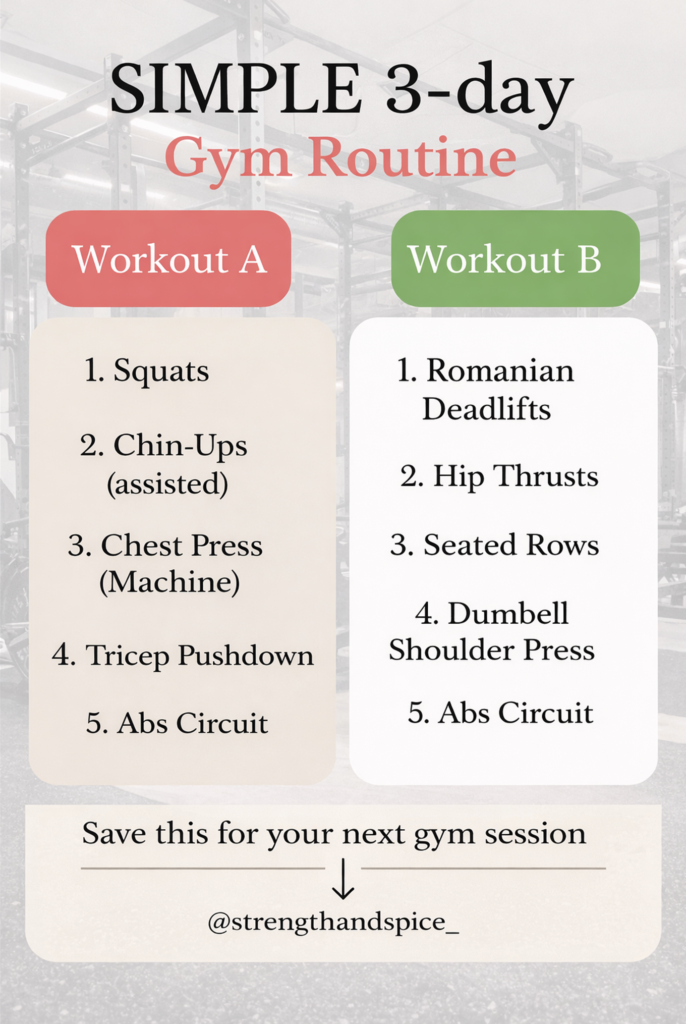
If you want this routine in a simple format you can follow in the gym, I’ve made a free PDF version.
Enter your email below and I’ll send it straight to your inbox.
By signing up, you’ll receive my routine + occasional emails from me. You can unsubscribe anytime.
Final Tips for Beginners
If you’ve made it this far, and you were looking for a simple beginner gym routine, this is probably all you need to get started.
The biggest mistake most people make is overcomplicating everything. They take something simple and turn it into a 5–6 day split with loads of random exercises, and then wonder why they can’t stick to it.
Keep it simple. Stick to the main movements, focus on doing them properly, and just aim to get a little bit better each week.
Track what you’re doing, be patient with it, and give yourself at least 8 weeks of consistency before you start changing things.
If you want more realistic gym advice and workouts, you can follow me on Instagram @strengthandspice_ where I share exactly what I do in the gym.
Follow me on social media for more simple workouts, high protein meals, and realistic gym content
More Posts You’ll Love:
About the author:

Hannah is a UK-based fitness content creator and qualified Level 2 Gym Instructor. She is currently working towards her Level 3 Personal Training qualification. Through Strength & Spice, she shares realistic, evidence-informed guidance on training, nutrition and building confidence in the gym. You can follow her training journey, food ideas, and educational content on Instagram at @strengthandspice_.


